
Polylaminin for Spinal Cord Injury: Scientific Mechanisms, Clinical Evidence, and the Future of Tetraplegia Recovery
Reviewed by Revievo Scientific Editorial Board
This article is intended for educational and informational purposes only and does not constitute medical advice. Experimental therapies should only be considered under qualified medical supervision and within approved clinical trials.
1. Introduction: Why Spinal Cord Regeneration Has Been a Medical Challenge
Spinal cord injury (SCI) represents one of the most complex and debilitating neurological conditions worldwide, affecting motor, sensory, and autonomic functions. According to global health authorities such as the World Health Organization (WHO), millions of individuals live with permanent disabilities resulting from traumatic or degenerative spinal cord damage [1]. The National Institute of Neurological Disorders and Stroke (NINDS) emphasizes that SCI research is a critical priority due to the severe impact on quality of life [2]. Historically, the adult central nervous system (CNS) has demonstrated limited regenerative capacity, primarily due to biological barriers such as glial scar formation, chronic inflammation, and intrinsic neuronal growth limitations [3]. These factors have contributed to long-standing clinical skepticism regarding meaningful neural repair.
2. What Is Polylaminin?
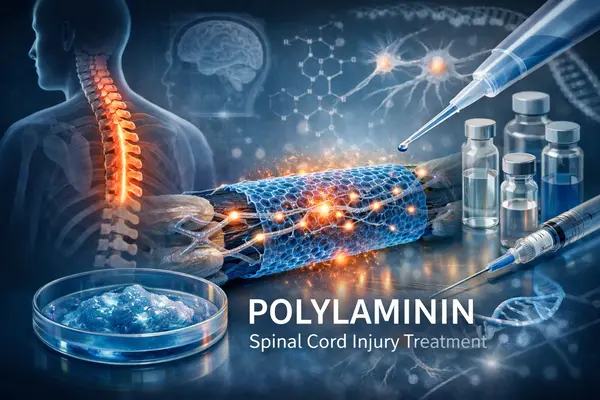
Polylaminin is a polymeric biomaterial derived from laminin, a fundamental extracellular matrix (ECM) glycoprotein involved in embryonic neural development and tissue organization [4]. Through controlled polymerization processes—specifically assembly triggered by pH acidification—polylaminin is engineered to replicate key structural and biochemical features of the developing nervous system. This biomimetic scaffold is designed to provide physical and molecular support for injured neural tissue, potentially facilitating axonal guidance and cellular stabilization in hostile post-injury environments [5].
3. Mechanism of Action: Cellular and Molecular Pathways
Following spinal cord trauma, inhibitory molecular signals and structural disruption impair axonal regrowth. Molecules such as Nogo-A are well-documented inhibitors that prevent nerve fiber extension [6]. Polylaminin is hypothesized to counteract these effects by interacting with integrin receptors, activating intracellular signaling pathways such as PI3K/Akt and focal adhesion kinase (FAK). These pathways regulate cytoskeletal organization, cellular adhesion, and neuronal survival, contributing to enhanced growth cone mobility and synaptic reorganization. By reconstructing aspects of the extracellular matrix, polylaminin may create a permissive microenvironment for functional reconnection [7].
4. Preclinical Evidence
Experimental studies in rodent and large-animal models have demonstrated that localized administration of polylaminin can promote axonal continuity across lesion sites. A seminal 2010 study published in the FASEB Journal showed significant motor recovery in rats treated with polylaminin compared to non-polymerized controls [5]. Functional improvements have been documented using standardized locomotor and sensory assessment scales, such as the Basso, Beattie, and Bresnahan (BBB) scale. Dose-response analyses suggest that therapeutic outcomes are influenced by concentration, delivery timing, and lesion characteristics. Histological evaluations further support structural remodeling and neuronal pathway preservation.
5. Human Observations and Early Clinical Research
Preliminary human investigations have explored the safety and feasibility of polylaminin in individuals with severe spinal cord injuries. A 2024 pilot study reported the return of voluntary motor contraction in patients with complete spinal cord injury [8]. These findings, while promising, remain exploratory and require validation through randomized, controlled clinical trials with extended follow-up periods. Regulatory agencies, including Brazil's ANVISA, have authorized initial Phase I safety assessments as of early 2026, reflecting cautious advancement toward clinical translation [9].
6. Comparison with Other Regenerative Strategies
Contemporary regenerative approaches include stem cell transplantation, neuromodulation systems, gene-based therapies, and neurotrophic factor delivery. Polylaminin differs by functioning primarily as a structural and biochemical scaffold, complementing biological and electrical interventions. Integrated therapeutic models may ultimately provide superior outcomes compared to isolated treatment modalities.
7. Scientific Debate and Methodological Considerations
Ongoing scientific discussion emphasizes the importance of rigorous study design, appropriate control groups, and standardized outcome measures. Media coverage of breakthroughs, such as those presented in major Brazilian news outlets, must be interpreted cautiously [10] [11], as early-stage research is susceptible to overgeneralization. Continued peer-reviewed investigation remains essential to separate clinical potential from experimental optimism.
8. Safety Profile and Risk Assessment
Potential risks associated with biomaterial implantation include inflammatory responses, fibrotic tissue formation, and unintended neural pathway alterations. Clinical protocols prioritize comprehensive monitoring to identify adverse events and establish acceptable safety margins. Long-term surveillance is required to assess durability and late-onset complications, especially following reports of adverse events in preliminary trials [12].
9. Regulatory Development and Clinical Pathways
Translation from laboratory research to clinical application requires multi-phase regulatory evaluation. These processes assess pharmacological stability, manufacturing consistency, clinical safety, and therapeutic efficacy. International regulatory alignment may facilitate broader research collaboration and standardized approval pathways.
10. Future Directions in Neuroregenerative Medicine
Advances in biomaterials, tissue engineering, and computational modeling are expected to enhance precision in neural repair strategies. Combination therapies integrating scaffolds, cellular therapies, and neuromodulation may represent the next phase of clinical innovation. Data-driven approaches may further personalize rehabilitation protocols.
11. Conclusion
Polylaminin-based therapies represent a scientifically grounded and promising avenue in spinal cord injury research. While early evidence supports biological plausibility and initial functional improvements, definitive conclusions require extensive, multi-center clinical trials. Continued interdisciplinary collaboration will be essential to determine the long-term clinical role of this technology.
Conflict of Interest Statement
The editorial team declares no financial or institutional conflicts related to the development or commercialization of polylaminin-based therapies.
References
- World Health Organization. Spinal Cord Injury Fact Sheet.
- National Institute of Neurological Disorders and Stroke (NINDS). Spinal Cord Injury Overview.
- Silver J, Miller RH. Regeneration beyond the glial scar. Nat Rev Neurosci. 2004 Feb;5(2):146-56. doi: 10.1038/nrn1326. PMID: 15034586.
- Colognato H, Yurchenco PD. Form and function: the laminin family of heterotrimers. Dev Dyn. 2003 Jan;226(1):124-43. doi: 10.1002/dvdy.10222. PMID: 12531535.
- Menezes K, et al. Polylaminin, a polymeric form of laminin, promotes regeneration after spinal cord injury. FASEB J. 2010 Nov;24(11):4513-22. doi: 10.1096/fj.10-157628. Epub 2010 Jul 19. PMID: 20643907.
- Chen MS, et al. Nogo-A is a myelin-associated neurite outgrowth inhibitor. Nature. 2000 Jan 20;403(6768):434-9. doi: 10.1038/35002062. PMID: 10659845.
- Fawcett JW. The extracellular matrix in neural repair and regeneration. Exp Neurol. 2014 Apr;254:1-10. doi: 10.1016/j.expneurol.2014.01.012. PMID: 24441870.
- Menezes K, et al. Return of voluntary motor contraction after complete spinal cord injury: a pilot human study on polylaminin. medRxiv [Preprint]. 2024. doi: 10.1101/2024.02.19.24301010v1.
- Ministério da Saúde e Anvisa anunciam aprovação de estudo clínico para tratamento inovador de lesões na medula espinhal. Gov.br. 2026 Jan 5.
- Groundbreaking Brazilian Drug Presented in São Paulo. Folha de S.Paulo. 2025 Sep 11.
- Medicamento inédito devolve movimento a pacientes com lesão na medula. CNN Brasil. 2025 Sep 11.
- Laboratory Claims Deaths After Use of Polylaminin. Registro Brasileiro de Ensaios Clínicos. 2026.
Editorial Note: Some links on this page may earn us a commission at no extra cost to you.
Our reviews remain independent and evidence-based.